
Coral Gables Previous Resident Sources
A Coral Gables address has several timelines. The current parcel card establishes the folio, owner, mailing address, legal description, sales, and building facts. The deed index then supplies the ownership chain. Directories and census schedules shift the question from title to residence, so they can reveal past residents who never owned the parcel. Maps, newspapers, and permits date the physical and social life of the site. Use the source closest to the period being studied, then confirm it with a record created for a different purpose.
| Source | Years It Covers | Where Held | What It Shows |
|---|---|---|---|
| Official Records web index | Most records from 1974 to present | Miami-Dade Clerk | Deed parties, dates, liens, mortgages, and references |
| Older deed books and indexes | Before 1974, with county series reaching to 1836 | Records Library and archives | Grantor, grantee, and legal description |
| Coral Gables and Greater Miami directories | Verified 1934 and 1939 editions, plus cited 1960s titles | State Library, FIU, HistoryMiami, LOC and NARA | Listed residents, spouses, work, and address |
| Federal census | Public through 1950 | NARA and library databases | Household members, ages, birthplaces, and work |
| Sanborn maps and city permits | 1924 maps; permit cutoff not verified | Library of Congress and Development Services | Building form, use, work, owners, and contractors |
For a post-1974 transfer, start online with the Miami-Dade Official Records information page. For earlier title work, keep the last known book, page, subdivision, lot, and block before contacting the Records Library. If ownership is already clear but the household is not, move to the directory and census checkpoints. That order reduces false matches and keeps the backward trail tied to the same land.
Begin With a Coral Gables Folio
The Miami-Dade Property Search accepts an address, owner name, subdivision name, or folio. Record the folio, situs address, owner mailing address, legal description, exemptions, sale references, and parcel map. Situs means the physical location assessed by the county. A mailing address is where the owner receives tax notices, and it may be a different home, a post office box, or an office.
The parcel card is not a list of everyone who lives there. A matching mailing and situs address, together with a homestead exemption, supports owner occupancy but still does not identify all household members. The folio is more useful than a name alone because trusts and companies often appear in Coral Gables title records. When an entity owns the parcel, read the deed image and resolve the entity separately before placing a person in the chain.
Note: Save the roll year with every parcel result because assessment data is edited continuously and may not reflect a very recent transfer.
Trace Miami-Dade Previous Owners
The recorded chain turns the current parcel into a sequence of prior owners. In a deed, the grantor gives or sells the interest and the grantee receives it. Search each seller as an earlier buyer, and confirm the same legal description at every handoff. This prevents a common error in which two people with the same name, or one person with several parcels, are merged into one Coral Gables house history.
- Copy the current owner, folio, and full legal description from the county parcel record.
- Find that owner's acquisition deed by searching the owner as grantee and narrowing the date and document type.
- Read the instrument. Copy the grantor, recording date, Clerk's File Number, book and page, and land description.
- Search that grantor as a grantee in an earlier date range. Confirm the same lot, block, plat, or folio before accepting the match.
- Repeat to the web boundary, then take the last references to the Records Library for older books and indexes.
- Grantor and grantee
- The grantor transfers an interest; the grantee receives it.
- Chain of title
- The linked series of recorded transfers for the same parcel.
- Legal description
- The lot, block, plat, or metes-and-bounds identity that stays useful when street wording changes.
- CFN
- The Clerk's File Number, a direct reference to one recorded instrument.
The ordinary index is free and most useful from 1974 forward. Advanced search units cost $1. Results can show party roles, document type, recording date, CFN, book and page, legal-description clues, and an image or copy route when eligible. The image may add addresses, documentary stamps, witnesses, notary details, and preparer information. Some sensitive images have access limits, so an index hit is not a promise of a downloadable image.
Review the County Recorder's Official Records page before searching. The captured page below confirms the official entry point used for Coral Gables deed research.
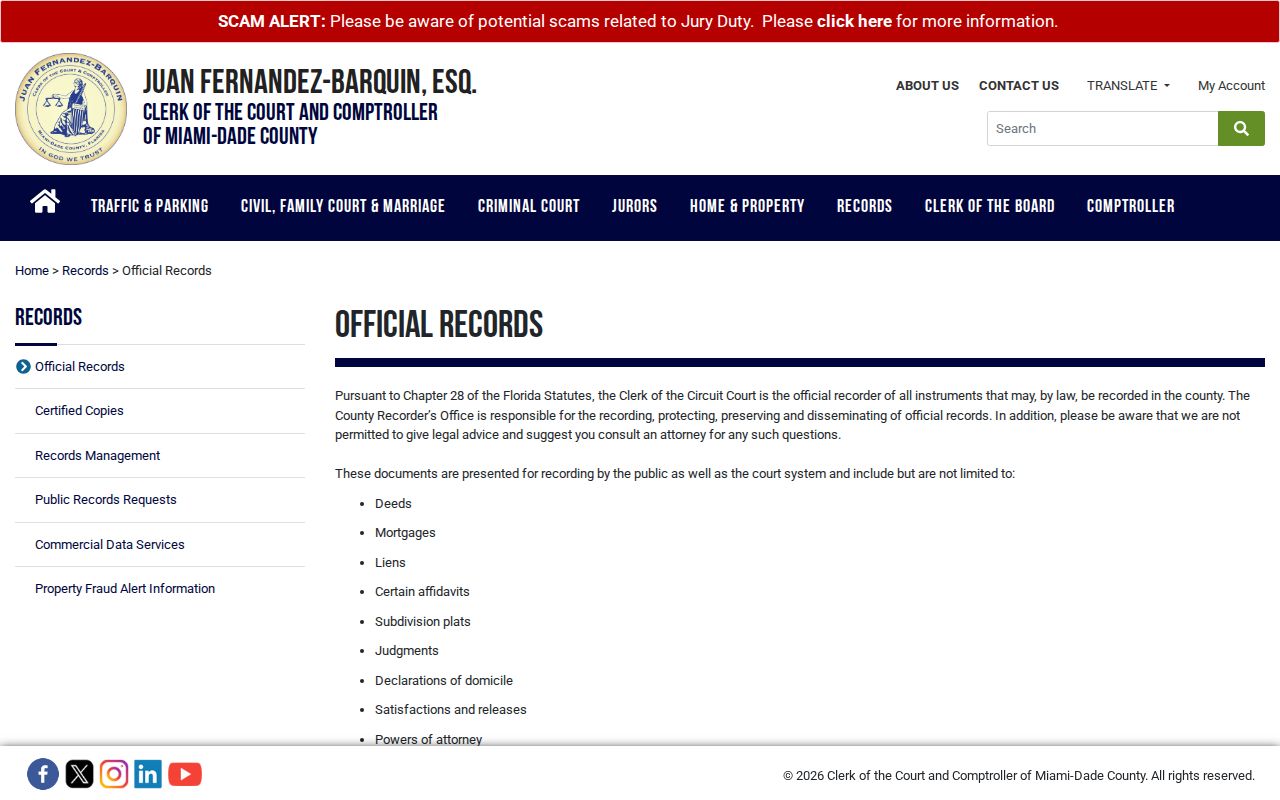
Keep its copy and library channels in reserve when the web index does not yield the needed instrument.
Past Residents Beyond the Web
Online coverage is strongest from 1974 forward. Earlier Coral Gables deeds remain a Records Library task while backfile imaging continues. At the counter, the public can search by a party written last name first, company, CFN, Official Records book and page, or legal description. Public computers and staff help are available. Mail requests may use a name, record type, legal description, or address, but a narrow request works far better than asking staff to reconstruct an entire house.
Staff searching costs $2 per name per year. That price makes date control important. Carry the last online deed backward with its recording year and book/page, then ask for the named grantor or grantee within a short range. Copies cost $1 per page, plus $2 per document for certification. A certified copy is an official copy attested by the Clerk; ordinary research rarely needs one unless an agency or formal proceeding requires it.
Save money. Narrow the person, year, subdivision, lot, and book/page online before asking Records Library staff to run a paid name search.
Coral Gables Addresses Shift
Coral Gables grew as a planned city inside a county created much earlier. A pre-1925 search belongs in Dade County land sources, not a nonexistent early city register. Historic street wording may also differ across Greater Miami directories, plats, and modern postal data. The research found no official, complete street-renaming chronology, so no date should be guessed when a number vanishes.
Use the legal description as the bridge. Compare the historic plat, the 1924 W.C. Bliss map, the Sanborn key sheet, and archive maps. Do not project a present ZIP back into an old directory. A postal label is also weak proof of city jurisdiction because several Coral Gables-serving ZIP codes cross municipal lines.
The Library of Congress 1924 Sanborn catalog record identifies Coral Gables within Miami volumes rather than as a separate bound title. Its 36 sheets document footprints, materials, use, street layout, and fire-risk details, not resident names. Pair the correct sheet with a directory or census entry before linking a household to the building.
Coral Gables Directory Checkpoints
The verified 1934 Coral Gables City Directory and the 1939 R.L. Polk Greater Miami directory provide two firm checkpoints. Later cited holdings include Miami and suburban editions from 1960, 1961, and 1963. A city-only catalog search can miss previous residents because publishers bundled Coral Gables under Greater Miami or suburban titles. The complete collection context belongs in the Coral Gables city directory, while an address history uses only the volumes closest to a known transfer or census year.
Start with the address or reverse section when present, then confirm the named person in alphabetical pages. Copy the spouse, work, residence mark, and ownership code exactly as printed. Directory entries came from a publisher's survey, so a missing name can mean refusal, lag, spelling trouble, or an unlisted occupant. It does not prove a vacancy.
Note: Try Miami, Greater Miami, and Miami Suburban catalog titles before deciding that a Coral Gables directory year is absent.
Map Coral Gables House Changes
Deeds date title, not every change to the structure. Sanborn sheets show historic footprints and uses. Coral Gables Development Services permits can add the owner or applicant, contractor, work description, value, and issue or final dates. The exact first online permit year was not verified, so older work may require a city records request. A permit applicant may be an agent or contractor, not a resident.
The city's zoning and parcel tools help confirm present municipal jurisdiction, zoning, future land use, and parcel context. Compare those facts with county title and tax records. A remodel date can explain a new unit or changed footprint, but it cannot by itself say when a household arrived.
Coral Gables Archives Close Gaps
The Valdés-Fauli Coral Gables Archives holds maps, photos, books, artifacts, and memorabilia, plus a linked run of city newspapers from 1941 through 1977. It is closed-stack and appointment only. Send the archivist a surname, address, date range, suspected map or newspaper title, and desired copy. That is much more useful than requesting everything about a house.
The archive page shown below is the local gateway for appointments and researcher requests.
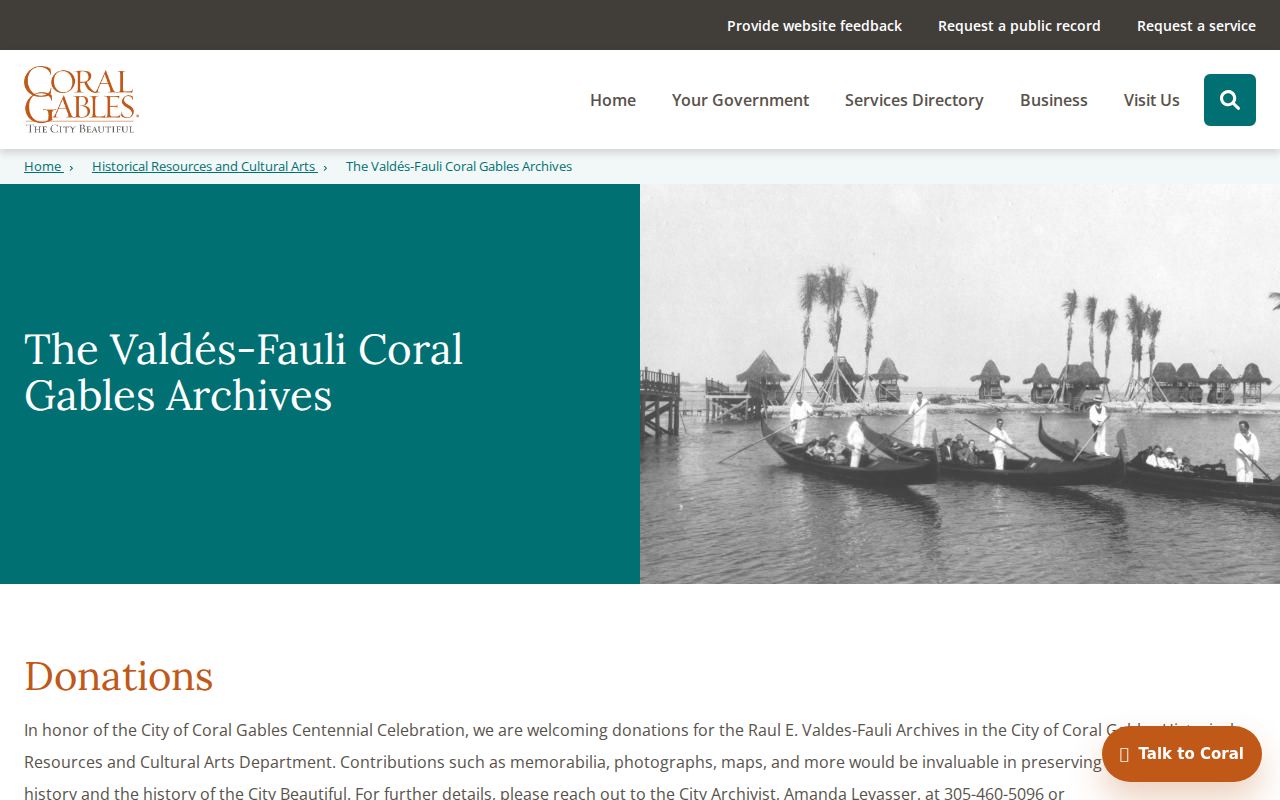
Its newspapers can connect a directory name to a social notice, death, sale, or civic event, but names and relationships should still be checked against deeds, census records, or official certificates.
Coral Gables Past Households
Previous owners are only half the story. A criss-cross directory arranges entries by street and number, so it can expose listed renters and household heads around an address. Public federal census schedules through 1950 add household members, ages, birthplaces, and work. Pair each available directory with the nearest public census, but allow for moves between publication and enumeration.
- Copy the exact address and all listed people from the nearest directory year.
- Find the census enumeration district, the small area assigned to one census taker, and inspect the matching address line.
- Compare names, ages, spouse or family ties, work, and nearby households.
- Repeat in the next directory and census checkpoint, noting every change instead of assuming continuity.
When a person disappears, search the 1941-1977 Coral Gables newspapers, obituary sources, cemetery material, and probate cases. Probate and a recorded personal-representative deed may connect a deceased former owner to heirs and explain a later title transfer. An obituary supplies relationships and places, but the deed or probate file is the better source for the legal handoff.
Lawful use. Research past residents for house history, family history, or personal curiosity. Never use an address trail to watch, harass, or harm a living person.