
Finding Coral Gables Residents
Begin with the fact you already know. An address belongs first in the Miami-Dade County Property Appraiser search, where Address, Owner Name, Subdivision Name, and Folio are separate routes into the roll. A person’s name can go into the recorder, court, business, or professional-license indexes. For an older address, the useful path shifts to deeds, printed directories, maps, newspapers, and census schedules. No source is a full roster. The tax roll names owners, not all people in a home, while the voter tool is an individual status check rather than an open block browser.
A sound Coral Gables residents directory search uses two independent points of agreement. Match a middle name or initial, date range, folio, legal description, spouse, business role, or case number. Treat mailing and property addresses as different fields. A trust or company on a deed may require a Sunbiz filing before an individual can be tied to it.
Choose the first source by the question, not by which search box is easiest. The assessor is best for a present owner and parcel. The recorder is best for a dated transfer or lien. A court index can confirm that a named party took part in a public case, while a vital certificate follows its own eligibility rule. Printed directories and newspapers are stronger for past households. When a portal returns nothing, retry initials, two surnames, dropped accents, old married names, and business entities before moving to the counter or archive.
- Check the county property roll by owner, address, subdivision, or folio.
- Use the Florida voter status tool only when its identity fields are known.
- Search Official Records for deeds, mortgages, liens, and releases.
- Ask the library or archive for directory years tied to an older address.
- Send a narrow chapter 119 request when the needed city or county file is not online.
Coral Gables Resident Record Keepers
Coral Gables is a city inside Miami-Dade County, and Miami is the county seat. That split controls where records live. The city keeps permits, zoning, code matters, agendas, correspondence, and archival material. Miami-Dade keeps assessment, deeds, most trial-court files, marriage licenses, and elections records. The Florida Public Records Law, grounded in article I, section 24 of the state constitution and chapter 119, lets any person ask a custodian for nonexempt records without giving a reason. A focused request should state the record type, name, date span, address or folio, and desired format.
A requester generally need not use a special form or identify a reason. There is no single fixed response deadline for all Florida records. The custodian must respond within a reasonable time and may charge actual duplication cost. A request that needs extensive information-technology, clerical, or supervisory work can carry a reasonable special service charge under section 119.07(4). If part of a file is exempt, the agency should redact that part and release the rest. Email sent to an agency can itself become a public record, so telephone or paper mail is an option for anyone who does not want to expose an email address.
Miami-Dade County Recorder
20 NW 1st Avenue, Suite 5.246
Miami, FL 33128
305-275-1155
Miami-Dade Property Appraiser
County assessment roll
Miami-Dade County, FL
Online parcel access
Miami-Dade Elections
County voter services
Miami-Dade County, FL
Individual and extract routes
Coral Gables Property Roll Clues
The Miami-Dade Property Search connects a parcel to its owner, folio, situs address, mailing address, values, exemptions, sales, and physical traits. Search by Address when the street number is firm, Owner Name when only a person or entity is known, Subdivision Name to browse a platted area, or Folio for the cleanest exact match. A separate suite field helps with multi-unit sites. Results can zoom to the parcel and show an aerial view.
The Coral Gables zoning and parcel page shows how the city adds a municipal layer to county parcel work.
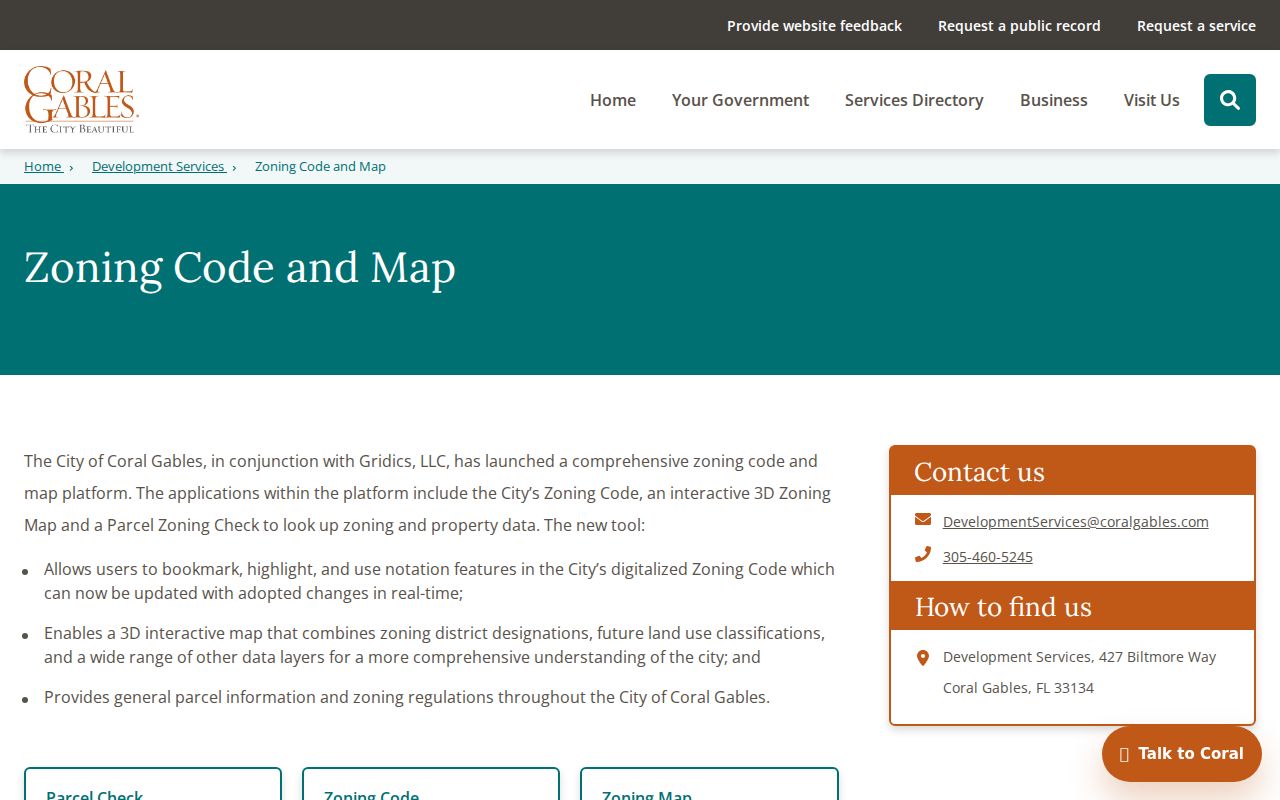
The city controls in this captured view help separate a postal address from a parcel that is truly inside Coral Gables.
| Search route | Best use | Key caution |
|---|---|---|
| Address and suite | Find the parcel at a known site | Postal city does not prove city limits |
| Owner name | Find assessed property ties | A trust or firm may be listed |
| Subdivision | Browse a platted community | Use the map to confirm each lot |
| Folio | Retrieve one exact parcel | Do not confuse situs with mailing address |
The assessment site warns that its roll is continuously edited and is not a title guarantee. It also does not list every occupant. In the 2025 preliminary roll, Coral Gables had 19,998 real-estate parcels, including 10,827 single-family parcels and 5,641 condominiums. That scale makes the map useful, but it also shows why a parcel-by-parcel check must stay precise.
A parcel card can carry more than a name. It may show the municipality or taxing authority, a legal description, land and building traits, assessed, market, and taxable values, exemptions, sales, and links to mapping or tax data. Read the situs and owner mailing lines separately. A matching mailing address can support an owner connection, while an out-of-area mailing address may point to a nonresident owner. Neither outcome identifies all people at the site. For the legal ownership chain, follow the recording reference into the Clerk’s index and inspect the actual instrument when public access allows.
Miami-Dade Deeds Add Dates
The County Recorder turns a current parcel into a dated ownership trail. Its index covers deeds, mortgages, liens, affidavits, plats, judgments, declarations of domicile, releases, powers of attorney, and other recorded instruments. Search by party name in last-name-first-name order, document type, date range, Clerk’s File Number, Official Records book and page, or legal description. Results may show names and roles, recording date, document type, instrument number, book and page, and a route to an eligible image.
Most recorded documents from 1974 forward are searchable online. Earlier work moves to the Records Library, where books and indexes remain available by mail or in person while backfile imaging continues. Staff research costs $2 per name per year. Public computers are available, copies cost $1 per page, and certification adds $2 per document. Narrow a request with a folio, legal description, year, or book and page before paying for a broad name search.
A mail request for a deed or mortgage should give the full name, document type, and legal description or address. For a certified copy, include book and page if known, recording year, parties, a self-addressed stamped envelope, and the proper fee. The standard index is free, while the advanced system uses purchased search units at $1 each. A deed index names grantors and grantees, but a trust or corporation can stand in place of an individual. The document image may add preparation, witness, notary, consideration, and address details, subject to redaction and image-access limits.
Current Coral Gables Resident Rolls
Modern directory work is a comparison of limited official lists. Each has a different reason for naming a person and a different date. Ownership, voter registration, a recorded filing, a professional credential, and a company role should not be treated as interchangeable proof of residence. Use the source whose purpose fits the question, note its date, and then look for a second record with a matching address, middle name, folio, business, or case.
| Source | Who It Lists | Keeper | Access |
|---|---|---|---|
| Property assessment roll | Owners and mailing contacts | Miami-Dade Property Appraiser | Free portal |
| Voter status and extracts | Registered voters, with exemptions | Miami-Dade and Florida Elections | Authenticated lookup or lawful extract |
| Official Records index | Parties to recorded instruments | Miami-Dade County Recorder | Free standard index |
| License and entity files | Licensees, officers, and agents | DBPR and Sunbiz | Free public search |
| Civic organization rosters | Public leaders and contacts | Publishing organization | Public page or permission |
Private association membership is not the same as a government roll. Public officer pages and newsletters can support a community-history search, but member-only lists require permission. For a name-first trail across current sources, use the dedicated Coral Gables resident lookup workflow.
Other official lists work only for narrow groups. Florida Treasure Hunt can connect a claimant name to a last-reported city or address, but a match does not prove current residence and the claimant must prove entitlement. State corrections and statutory safety registries have their own legal purpose, scope, warnings, and correction routes. They should never be presented as a general roll of Coral Gables residents. The most useful directory is therefore a source map: it tells what each list was made to record, when it was updated, and which custodian can correct it.
Coral Gables Voter Record Limits
The Florida registration-status lookup asks for first name, last name, date of birth, and county. Those fields authenticate one person; they are not a way to sweep a street. Miami-Dade Elections is the correction point for county registration and precinct data. Florida also produces monthly public voter extracts from all 67 supervisors, covering active and inactive registrations through the prior month. Public fields can include name, nonexempt residence or mailing address, party, registration date and status, precinct, district, and election participation history. Ballot choices are never shown.
Florida Statutes sections 97.0585 and 119.071 keep Social Security numbers, driver-license or state-ID numbers, signatures, source-agency data, and qualifying protected addresses out of public view. An inactive status does not prove when someone moved. A county update can also appear before the next state extract. Precinct maps are especially helpful in Coral Gables because postal ZIPs cross city lines.
The monthly extract reports election participation, not how anyone voted. It may include active and inactive records through the last day of the preceding month, so date the file before relying on it. Address Confidentiality Program participants and people covered by occupational exemptions will not expose a useful home address. If a lawful lookup disagrees with another record, the Supervisor of Elections is the right office for registration correction. Do not repeatedly harvest an authenticated individual tool to build a street list; use the proper extract channel and comply with its conditions.
Coral Gables Municipal Evidence
City records fill gaps left by county rolls. The Coral Gables City Clerk provides a Laserfiche document route and accepts public-record requests for agendas, minutes, ordinances, appointments, petitions, correspondence, and other municipal files. Development Services keeps permit, planning, zoning, and code material. A permit may identify the applicant, owner, contractor, property address, folio, work description, value, dates, and status. Code files can add the site, respondent or owner, hearing, and compliance events.
The city’s digital zoning code, interactive 3D zoning map, and Parcel Zoning Check can confirm whether an address is within Coral Gables, then show zoning, future land use, and general parcel data. This matters because a Coral Gables postal label is not enough. When an online system lacks the needed file, send the City Clerk a narrow chapter 119 request with the address, record type, date span, and preferred format.
Permit names are dated evidence, not a full residents directory. An old application may preserve a then-current owner or applicant, so compare it with today’s county assessment roll before drawing a conclusion.
The Valdés-Fauli Coral Gables Archives is the city’s strongest local-history fallback. Staff retrieve material from the closed stacks, so researchers arrange an appointment and submit a request in advance. The collection includes documents, books, maps, photographs, artifacts, memorabilia, and South Florida material. A productive inquiry states the person or address, approximate year, likely directory, newspaper, or map, and desired copy. The archive is at 234 Minorca Avenue and lists City Archivist Amanda Levasser at 305-460-5096. Broad requests take more work than a short, dated list.
Coral Gables Court Name Checks
Miami-Dade’s Clerk separates Civil, Family, and Probate searching from the Criminal Justice Online Case Search. A party search may use last or business name, first name, case number, a date range, and a court or case category. Results can show party role, case number, judge or division, filing date, case type, status, docket events, and public documents. The criminal portal uses record cards; expanding a docket entry can expose an image icon and certified-copy route when access rules allow.
A same-name case is not an identity match. Compare dates, counsel, permitted address facts, related recorded judgments, and probate estate details. Sealed, expunged, juvenile, adoption, and other confidential records will not appear. Older or non-imaged files may require the division, case number, and a direct copy request. Federal matters route to the Southern District of Florida through PACER or a courthouse public-access terminal.
The web display is not the official court record. Registration can reduce captcha and guest-search limits in the county criminal system, but it does not expand access to sealed data. Clerk staff can explain copy procedure and public access, not give legal advice. A no-result may mean the name is indexed differently, the matter is in another Florida county, the file predates online coverage, or the record is confidential. Check the proper division before deciding that no case exists.
Florida Licenses and Company Ties
Sunbiz Document Searches supports entity, officer or registered-agent, trademark, FEI, document number, ZIP, and street-address searches. A filing can connect a person to a principal or mailing address and show status, agents, officers, managers, and dated annual-report images. That helps resolve a parcel held by a corporation or limited liability company without assuming the company name identifies its residents.
The Florida DBPR license search covers many regulated trades and services seen in Coral Gables. Its fields include license category and type, city, county, state, and an option to include historic licenses. Health practitioners, lawyers, and educators use separate state or professional systems. A credential establishes a public professional tie, not where someone sleeps. Match the license record to another dated source.
DBPR detail can include license number, type, status, location, related licenses, and public discipline. Complaint pages may show a number, class, incident date, status, disposition, and disposition date, while active investigations and some complaints stay confidential. Sunbiz annual-report images are often better than the current summary when a dated address matters. Preserve the filing date and distinguish a principal address, mailing address, and registered-agent address. One company can use all three for different purposes.
Coral Gables ZIP Boundary Trap
City sources support six ZIPs serving parts of Coral Gables: 33133, 33134, 33143, 33146, 33156, and 33158. The two central codes dominate, but the others overlap Miami, Coconut Grove, South Miami, Pinecrest, Kendall, Palmetto Bay, or unincorporated land. USPS confirms delivery format and ZIP+4. It does not settle municipal jurisdiction, title, or occupancy.
Confirm a location with the county folio and municipal map. A city survey, polling sites, parks, and public facilities help document the six-code pattern, while the property roll and Coral Gables Parcel Check answer whether one parcel is actually in the city. This geographic check prevents a resident search from drifting into a neighboring jurisdiction just because the mailing address says Coral Gables.
The record key also changes by source. USPS uses a deliverable street address. The assessor uses situs, mailing, subdivision, and folio. A deed relies on party names and the legal description, which can be lot, block, plat book and page, or metes and bounds. A voter file uses residence and precinct. Sunbiz stores filed company addresses. For an old street name or an altered address, the legal description and folio are the stable bridge across systems.
Coral Gables Vital Record Rules
Birth, death, marriage, and divorce records do not share one access rule. Florida births less than 125 years old are confidential and limited to eligible requesters. Death copies without cause are broadly available, while cause of death stays confidential for 50 years except for eligible family members and representatives. Marriage certifications and state dissolution abstracts are public. The Miami-Dade Clerk keeps the marriage license and full divorce court file, while the state certificate is an abstract reported by clerks.
The Florida Bureau of Vital Statistics accepts mail, walk-in, and approved online orders; Miami-Dade health offices are a local birth and death channel. Older events may require churches, cemeteries, newspapers, county files, or archives because statewide registration does not cover all early records. Use official applications, supply the requested identity and eligibility proof, and avoid treating a no-result as proof that an event did not occur.
The birth application requests the full name on the record, sex, date or search span, city and county of birth, parents’ names before first marriage, applicant contact details, relationship, and signature. A valid ID is required, and a person outside the direct eligibility group needs the designated notarized authorization and IDs. A marriage request instead asks for both spouses’ names before marriage, date or range, county, contact data, quantity, and certificate type. Since marriage records are public, the state application does not require ID.
Historic Coral Gables Resident Directories
Coral Gables incorporated in 1925, inside a county created much earlier. A researcher should not expect a pre-1925 municipal register. The verified directory trail includes a standalone 1934 Coral Gables City Directory and R.L. Polk’s 1939 Greater Miami volume, which expressly includes Coral Gables. Later Miami and Miami Suburban Polk titles and a Greater Miami telephone directory also cover the area. Catalog searches limited to the city name can miss residents because publishers bundled the planned city into a wider Miami market.
The State Library of Florida holds more than a century of city directories. FIU digital collections, HistoryMiami’s Research Center, the Coral Gables Branch Library, and University of Miami Special Collections add scans, reference help, yearbooks, maps, and regional material. The Valdés-Fauli Coral Gables Archives is a closed-stack collection reached by appointment. Its maps, photographs, memorabilia, and linked Coral Gables newspapers from 1941 through 1977 can bridge gaps between a directory entry and a later probate or vital record.
A directory entry may show name, spouse, occupation, employer, and home address, while a reverse section turns an address into nearby household names. Photograph the abbreviation key before reading codes. Then pair a directory year with the 1930, 1940, or 1950 census, a deed, and a newspaper notice. The full collection and entry method appears in the Coral Gables city directory guide.
The 1924 Sanborn Miami volumes identify Coral Gables as a secondary location across a 36-sheet set. Their building footprints, construction details, and street context can be paired with the W. C. Bliss map of entrances, streets, gates, and squares. These maps do not name every resident. They explain the physical setting around an address and can help resolve a street that later changed. In the MacFarlane area, also test Miami and Coconut Grove labels because historic cataloging and community boundaries do not always match the modern city name.
When Coral Gables Records Go Offline
Online coverage has real edges. Recorder searching is strongest from 1974 forward. The Valdés-Fauli archive is staff-mediated and appointment-only. Some library databases work only with a card or inside a branch, and court images can be more restricted than docket data. A complete access plan therefore includes the web index, public terminal, phone, mail, records request, library desk, and archive appointment when the research calls for them.
For early deeds, ask the Records Library with names, document type, year, legal description, and book or page if known. For local history, give the city archivist a person or address, date range, suspected map, newspaper, or directory title, and desired reproduction. At the Coral Gables Branch, ask specifically about Miami and Coral Gables Polk directories, suburban directories, telephone books, newspapers, yearbooks, and genealogy databases rather than assuming every item is on the local shelf.
The archive’s centennial donation effort adds a local twist: family photographs, maps, and memorabilia can enter the civic collection through residents, not just through formal city record series. Those items may supply context, but names and dates should still be checked against official records.