
Coral Gables Directory Collections
The local directory record is not one unbroken shelf. Coral Gables became a city in 1925, and verified publications begin in that development era. Earlier people may be cataloged under Miami, Dade County, Coconut Grove, or agricultural sources. Later publishers often treated the city as part of a wider market. That title shift is central to a sound search.
| Collection | Verified years | Where held | Access |
|---|---|---|---|
| Coral Gables City Directory | 1934 | Genealogy digitization catalogs | Provider access varies |
| R.L. Polk Greater Miami City Directory | 1939 | FIU Digital Collections scan | Online PDF |
| Miami directories | 1929–1932 | NARA and Library of Congress inventory | Research room or microfilm |
| Polk Miami and Suburban titles | 1960, 1961, 1963 | HistoryMiami and regional collections | Catalog or appointment |
| Florida city directories | Early 1900s to present collection span | State Library of Florida | On-site and catalog help |
| Coral Gables newspapers | 1941–1977 | Valdés-Fauli Archives portal | Linked digital collection |
| Sanborn Miami volumes | 1924, volumes 2–3 | Library of Congress | Free scans |
| Federal census | Public through 1950 | NARA and library databases | Free indexes or licensed databases |
No official, browsable catalog supplies an exhaustive list of every Coral Gables or Greater Miami volume. Treat these years as verified checkpoints, not proof that every intervening edition exists. Search adjacent years and alternate geographic titles before calling a gap permanent.
Coral Gables Directories After 1925
Dade County was formed in 1836, but the planned city was incorporated on April 29, 1925. There is no pre-1925 Coral Gables municipal register to find. The trail moves from county land material and early maps into subdivision plats, promotional records, city files, and directory books.
| 1924 | W.C. Bliss and Sanborn mapping records the emerging street and building pattern. |
|---|---|
| 1925 | Coral Gables incorporates and begins its municipal record era. |
| 1934 | A standalone Coral Gables city directory is verified. |
| 1939 | R.L. Polk explicitly includes Coral Gables in Greater Miami. |
| 1941–1977 | Local newspapers now linked by the city archive bridge directory gaps. |
| 1960–1963 | Verified Miami, suburban, and telephone titles continue regional coverage. |
This is a jurisdiction-and-title story, not a courthouse-loss story. George Merrick's planned community entered an older county system, then publishers bundled its households into Greater Miami. A person can vanish from a city-only catalog query while remaining plainly listed in a regional book.
Note: Search Miami and suburban catalog terms whenever a Coral Gables title yields no match for the target year.
Reading Coral Gables Directory Entries
The 1939 Polk volume shows how much can fit on one compressed line. Entries commonly place surname first, followed by a given name or initial. A spouse may appear in parentheses. An occupation, employer, home address, rooming address, or business address may follow. Widows may be marked with “wid” and the deceased spouse's given name.
| Name | Surname, given name or initials, with spelling as printed. |
|---|---|
| Spouse | Often printed in parentheses beside the listed person. |
| Work | Occupation or employer, sometimes with a business address. |
| Residence | “h” can mark a home address and “r” a rooming address. |
| Family clue | “wid” can identify a widow and name her deceased spouse. |
| Status mark | Edition-specific coding must be checked against the key. |
The publisher's survey is evidence, not a government certification. People could refuse, be missed, use initials, board with another family, or move before publication. Copy the full line and page, then seek another source dated near the same time.
- Criss-cross directory
- A section arranged by street and house number instead of surname.
- Householder index
- An address-order list of people treated as household heads.
- Abbreviation key
- The edition's legend for short forms and symbols. It controls how residence, work, widowhood, and status marks should be read.
Coral Gables in Greater Miami
A city directory search limited to “Coral Gables” misses a core run. The introduction to R.L. Polk's 1939 Greater Miami volume expressly names Miami, Miami Beach, Coral Gables, Hialeah, Biscayne Park, Miami Shores Village, and North Miami. Later citations confirm a Miami directory in 1960, suburban directories in 1961 and 1963, and a Southern Bell Greater Miami telephone book in 1962.
The 1939 introduction also calls out a new tenant-owned-home designation. That feature is useful only when read through the printed abbreviation key. It does not turn the entry into a deed or prove who held title. Match an ownership mark to county records before treating it as more than a publisher's notation.
Catalog rule. Test Coral Gables, Greater Miami, Miami, Miami Suburban, Polk, and telephone-directory terms as separate searches.
Coral Gables Directory Research Desks
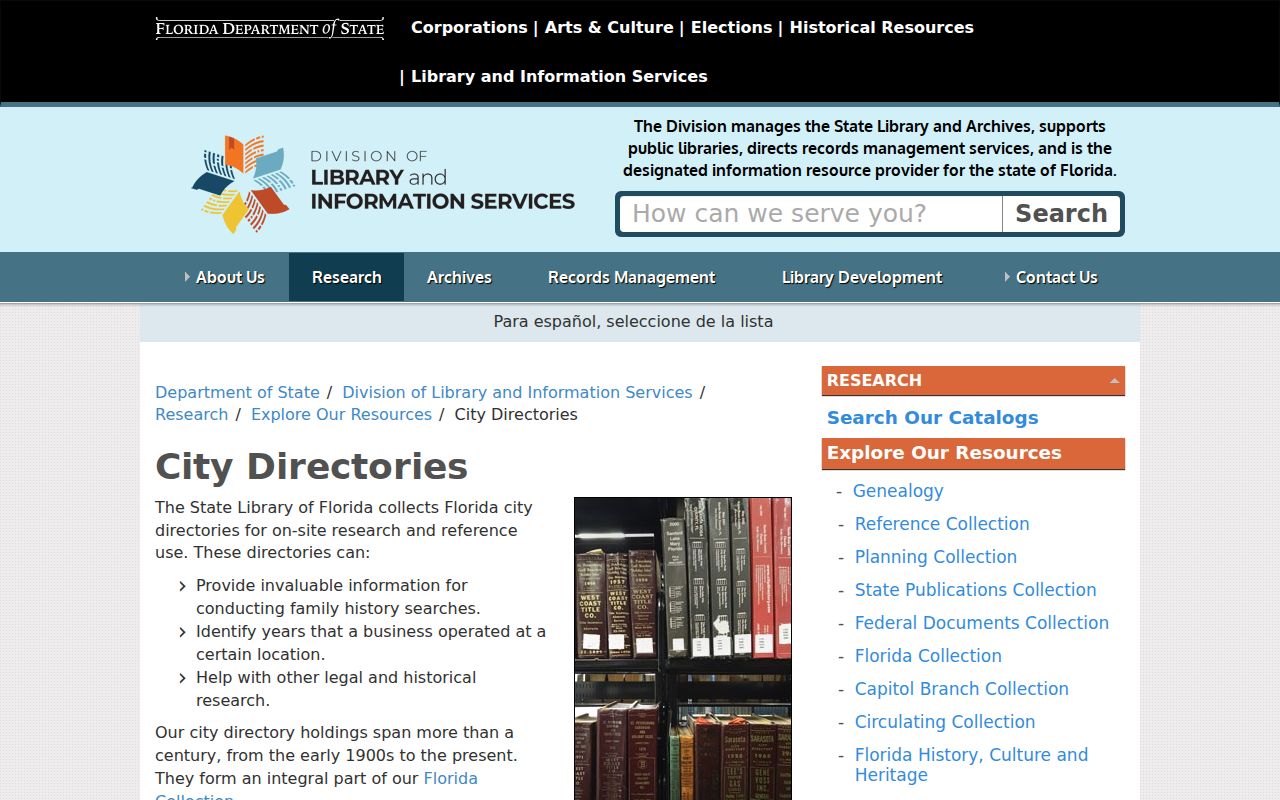
The State Library of Florida city directory collection spans more than a century and is organized by city, then date. Its catalog is a strong place to test alternate titles. Reference staff can be reached at 850-245-6682. The Library of Congress microfilm inventory is another route for Miami's 1929–1932 run.
The State Library page shows the statewide collection and research path.
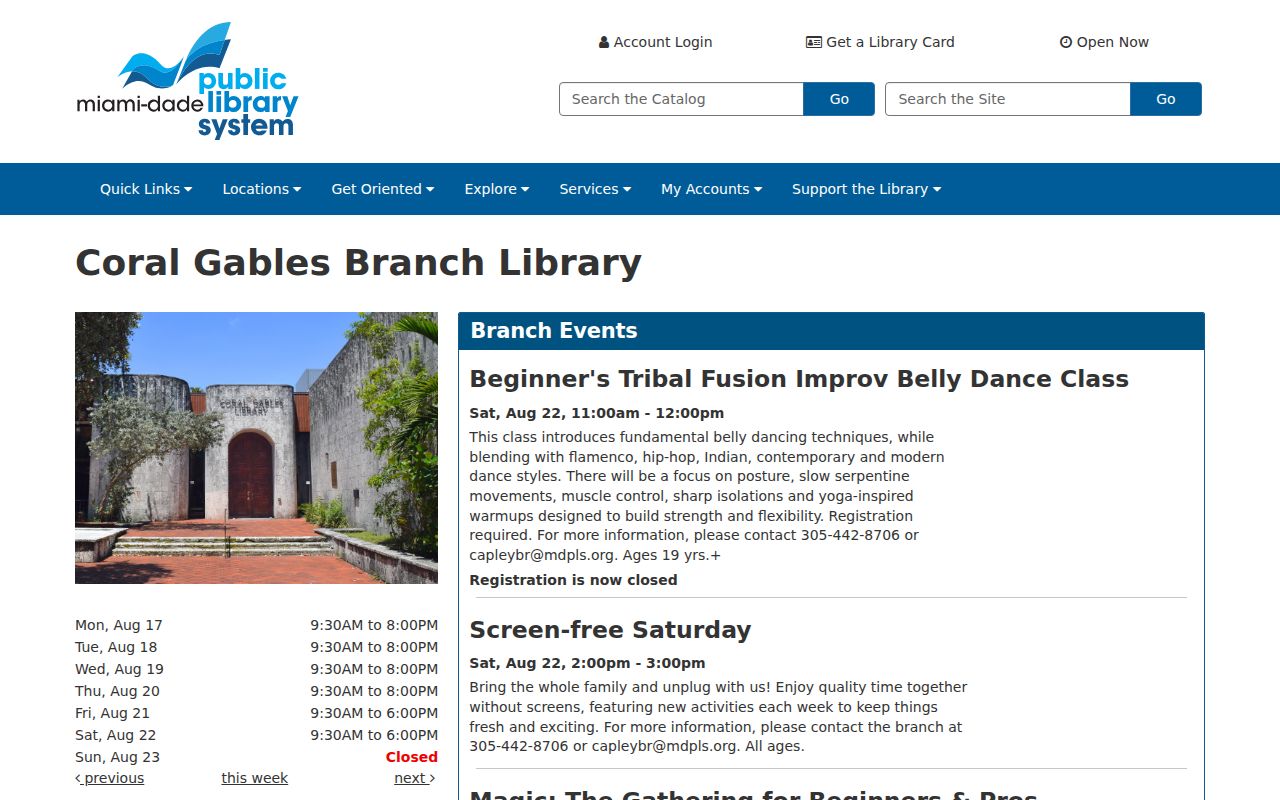
The Coral Gables Branch Library, 3443 Segovia Street, is the local entry point for reference help, databases, and referrals. Ask about Miami and Coral Gables Polk volumes, suburban directories, telephone books, newspapers, yearbooks, Ancestry Library Edition, and HeritageQuest. The title may be held at Main Library or another institution.
The branch page shows the local reference desk that can route a question to the right collection.
Coral Gables Archives Close Gaps
The Valdés-Fauli Coral Gables Archives holds maps, photographs, books, artifacts, memorabilia, and local records. It is closed-stack and appointment-only. A useful request names the person or address, approximate date, suspected newspaper, map, or directory title, and desired reproduction.
The archive page links digitized Coral Gables newspapers from 1941 through 1977. Search a surname and address together, then use notices and obituaries to explain why a name appeared, moved, or vanished. City Archivist Amanda Levasser can be reached at 305-460-5096 or alevasser@coralgables.com.
The archive's online description shows why an appointment and a focused request matter.
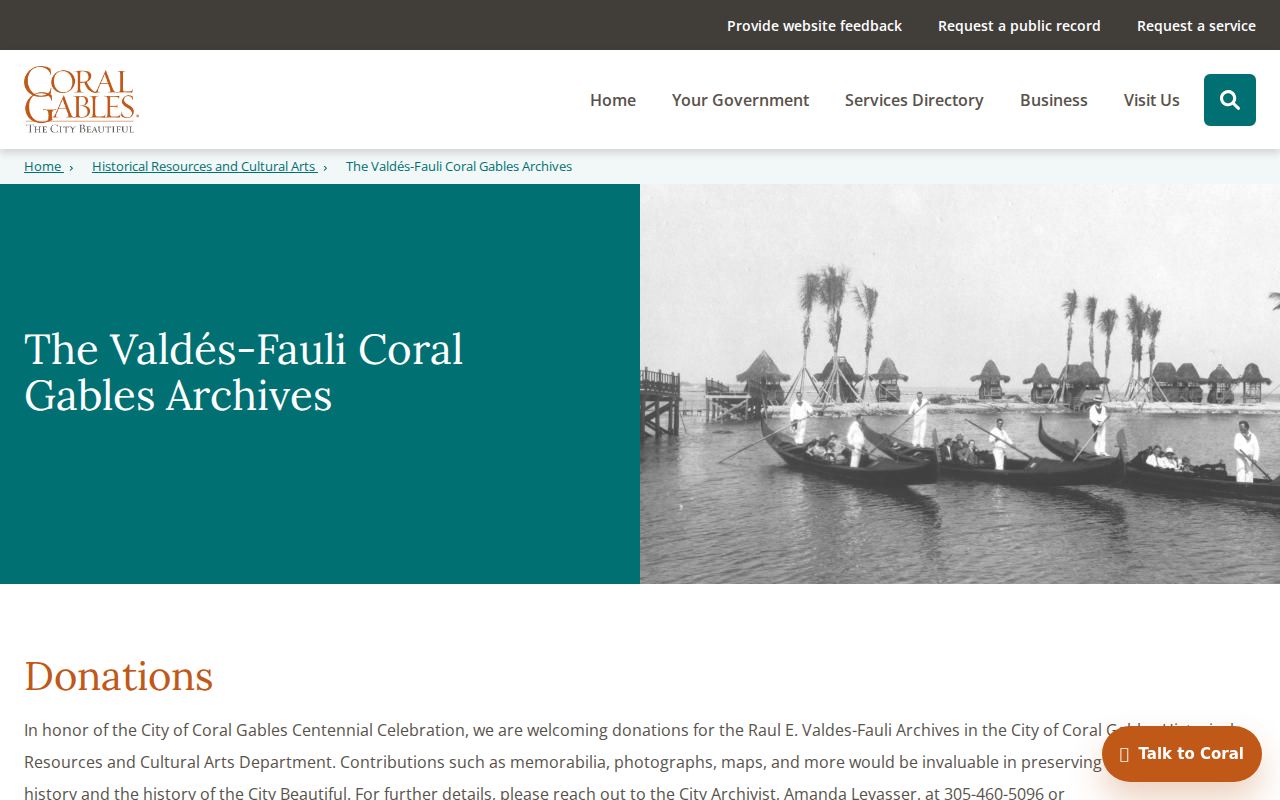
A centennial donation effort invited family photographs, maps, and memorabilia. A household trail may therefore enter the archive through private family collections, not just a formal city series.
Map Coral Gables Directory Addresses
The Library of Congress 1924 Sanborn set identifies Coral Gables as a secondary location within 36 sheets across Miami volumes 2 and 3. Use the key map first. The sheets record building footprints, construction material, street layout, use, and fire-risk features, but not resident names.
Pair a structure with a near-date city directory entry. The map can show whether a house number existed and whether the building changed, while the directory supplies a listed person. The 1924 W.C. Bliss map of entrances, streets, gates, and squares helps bridge historic street layouts. MDPLS Digital Collections, including the 10,000-plus image Gleason Waite Romer collection, adds context from the early 1900s through the 1960s.
Older northern and central areas suit this pairing. Later southern development depends more on plats, permits, deeds, and aerials because it came after the earliest mapped years.
Coral Gables Directory Companion Sources
University of Miami Libraries Special Collections can hold yearbooks, maps, newspapers, manuscripts, and regional material. A yearbook can verify affiliation or class year, though it does not prove permanent city residence. HistoryMiami's Research Center keeps directories, telephone books, maps, photographs, and organizational files.
Church bulletins, civic programs, Garden Club material, veterans' groups, and historical newsletters may place a person in the community. Public officer lists are useful leads. Private membership books still require permission. Funeral notices, newspaper archives, and cemetery sources can connect spouses, children, and dates, but official records should confirm key life events.
Spanish and bilingual name forms need care. Test both surnames, hyphens, spaces, initials, married names, and forms without diacritics. Older typeset indexes can hide a correct entry under a small spelling change.
Trace Family Through Coral Gables Directories
A household should be followed in both directions. Begin with the year nearest a known event. Record the whole entry, not just the name. Then move one edition earlier and one later. Changes in spouse, work, or address can narrow the next search.
- Find the surname in alphabetical pages and test initials and alternate spellings.
- Copy the spouse, work, home address, symbols, volume year, and page.
- Consult the key, then check the street-order section and nearby listed households.
- Repeat in surrounding years, including Greater Miami and suburban titles.
- Pair the trail with the public 1930, 1940, or 1950 census when dates fit.
- Use newspapers, deeds, probate, or an obituary to explain a move or final disappearance.
The federal 72-year release rule makes census records public through 1950; the 1960 census opens in 2032. Census schedules can show household members whom city directories left out. A deed proves title rather than presence, so it answers a different question. For today's parcel search, use the Coral Gables street directory.
Note: An absent listing can mean a move, death, refusal, publisher omission, or a change in the title covering Coral Gables.